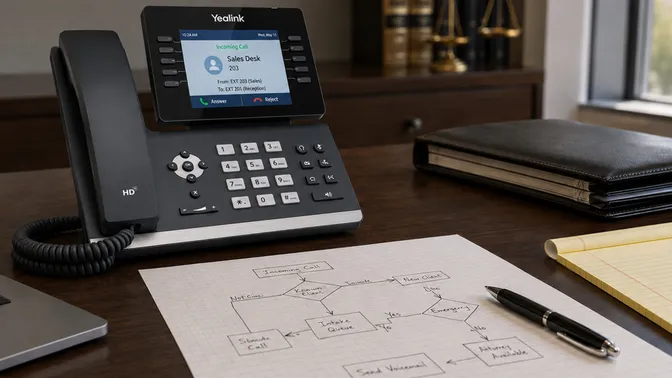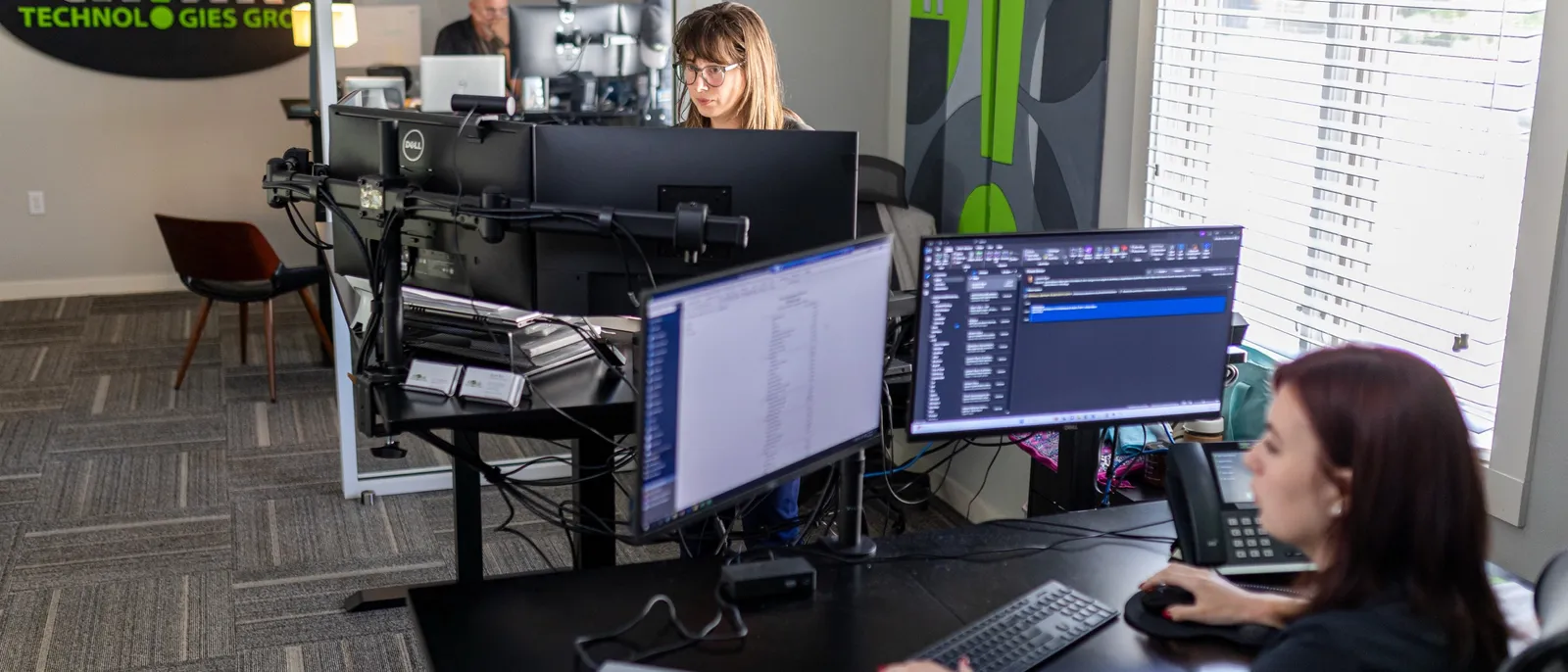
Fully managed means your phone system stops being something you have to think about.
We run it. We change it as your business changes, and we fix it when something goes wrong. Adding extensions when you hire, rerouting calls when you reorganize, applying system updates when they’re released, answering the phone when you call us about a problem: all of it is our job, and all of it is included in what you already pay. The phone system disappears into the background of your week. Something you notice only when it rings.
The rest of this post is what that looks like day to day — specific enough to compare against what your current provider does.
The phrase is everywhere. The definition isn’t.
Search “managed VoIP services” or “managed phone system” and you’ll land on the same set of pages: RingCentral, Nextiva, 8x8, Vonage, Dialpad. Read what they say their product is.
You’ll find AI talk, “unified communications,” integration counts, and award badges. You’ll find feature comparisons, call center add-ons, and an enterprise tier for features most customers don’t need.
What you’re unlikely to find is the phrase “fully managed.”
At the scale those companies operate, they can’t commit to it. Managing a hosted VoIP system — setup, configuration, training, changes, troubleshooting, bill reviews — is expensive. It requires people and continuity. You can’t scale that with a ticket portal and an offshore first line. You can scale software that way, which is why they sell software.
Some regional competitors do use the phrase, including several in Florida. They mean well. But they tend to use “fully managed” the way a restaurant menu uses “artisan”: as a feature claim next to “cloud-hosted” and “24/7 support,” not as a service model you can verify.
The portal nobody uses
We have a customer portal.
You can log in, submit tickets, see the status of open work, review past requests. It does what a portal is supposed to do. If you want to use it, it’s there.
Our voice-only customers almost never do.
Our co-managed clients use it. These are businesses where one person handles phones and IT, and they’ve brought us in to help with both. Those people live in a portal for their workday, so they want the phone system visible there too. That makes sense.
Everyone else picks up the phone or sends an email. When something’s off, they don’t want to fill out a form. They want to tell somebody.
This is the part most providers assume they can’t afford. A portal scales; personal support doesn’t. When you’re supporting a hundred thousand customers at once, automating intake is the only real option. We’ve built a different kind of operation, one where answering the phone is part of the work. Our customers would rather make the call.
From dispatch to callback
When you call us, here’s what happens.
Someone answers. That person isn’t going to fix your problem. Their job is intake and triage: getting the right information into a ticket and handing it to the right person internally.
Emails hit our ConnectWise connector. It opens the ticket automatically, confirms receipt with you, and notifies dispatch.
From there, dispatch routes it to an engineer based on the skills the ticket needs and who’s available to take it. We keep thorough documentation on every account, so whoever picks up your ticket has the context they need to help. And on a team our size, that engineer has often already worked on your setup.
That engineer calls you back.
The typical callback window is 30 minutes to an hour. Depending on the day (Monday after a long weekend, Tuesday before Thanksgiving) it can stretch. It’s not instant; we don’t claim it is. When the callback happens, the person on the other end knows your system. You don’t re-explain the problem. You don’t get transferred. You don’t get handed to a junior tech taking notes so they can escalate it to someone who can actually fix it.
Compare that to the usual national-provider experience. You open a portal ticket. Someone acknowledges it. A day later a first-tier agent emails asking for information that was already in the ticket. You reply. Another day passes. They escalate. A new person responds. You re-describe the problem. Eventually you may reach somebody who can help. By that point it’s been a week and you’ve explained the issue four times.
Our version is slower than “live help” in the first ten seconds. It’s faster than by next Tuesday.
Changes happen when you ask
Most of the ongoing work on a phone system isn’t fixing things that break. It’s changes. You hire someone and need an extension by Monday. You restructure the front desk and need the call queue priority swapped. You’re opening a second location and need after-hours routing adjusted. You’re going on vacation and need calls to roll to your assistant for two weeks.
These requests come in constantly, and they’re already part of what you’re paying for. There’s no change-order invoice. There’s no “submit a quote request first.” You call or email, we update, and the phones work the way you need them to by the time you need them to.
Lauren runs our implementations and training. If you’ve been onboarded to our managed phone service, she’s the one who built your system: configured the call flows, ported the numbers, set up the auto attendant, and trained your team the day you went live. Day-to-day changes after that go through the small group of engineers on our team who handle most of our phone work. Sometimes that’s Lauren. It’s always someone who can DM her with questions.
At national scale, change requests work differently. A ticket hits a queue, whoever’s next picks it up, reads the account summary, and does what the script tells them. Anything nonstandard gets escalated. Anything that looks like custom work gets quoted as additional services. A simple extension add can take two weeks and a change-order approval process.
The holiday calls
Every holiday, the same thing happens.
Someone on a customer’s team forgot to set their holiday greeting. They’re sitting at home on Christmas Eve, or the Friday after Thanksgiving, or the morning of the 4th of July, and they realize it. They pick up the phone and call us.
Our on-call engineer logs in and sets it.
This isn’t 24/7 coverage as a feature bullet. It happens every holiday we work. The engineer eating dinner grabs their laptop, signs in, updates the auto attendant, and is back to dinner in ten minutes. The customer, who was about to have a miserable long weekend knowing their phones were ringing at an empty office, goes back to their family.
We don’t refuse the call, and we don’t push you to Monday. The engineer handles it the same way they’d handle any change request: something the managed provider is supposed to take care of, quietly, so it doesn’t become a thing.
If this sounds like what you want
If all of that sounds like what you want from a phone system provider, that’s what we do.
Call us at 844-767-1924 or tell us about your setup and we’ll take it from there. We’ll review your current bill and setup — what’s working, what isn’t.
If you’re happy where you are, close the tab. We wrote this for the people who aren’t.